***Trigger warning: brief mention of sexual assault
When the Supreme Court overturned Roe v. Wade I, like so many were gutted. Something as simple as choosing what goes on inside your body was now vulnerable, if not outright banned. I’m lucky, I live in New York which is a blue state, so my right to choose will likely not be revoked, but I am a minority. For so many women they have been reduced–their independence, their sovereignty disrespected. Yet again women are deemed less than; that they cannot make decisions for themselves. As a Lilith devotee I am outraged for my fellow women. Have we not fought tooth and nail to be treated even slightly equal as men? Have we not proven that we can “handle” ourselves? Again patriarchy needs to put women back under their rule.
Yes I am pro-choice. The choice to have an abortion is the choice to not be pregnant, to not bring life into this world, to honor yourself as a human being. In the case of tragedies and injustices of sexual assault, incest, and abuse, the punishment should not rest with the women should she become pregnant. Those who endure these traumas and find a lingering presence should be able to reclaim their stories. To me that is what being pro-choice means: the choice to write your own story; the right to control the way your life unfolds.
Those who argue against that choice claim that it is murder. That is one way to read that story, but I would counter that forcing someone into motherhood is it’s own kind of murder. Motherhood is an identity that many are privileged to don, but it can smother the woman who came before. That kind of shift in a story cannot be taken lightly and therefore should not be forced. It should be celebrated.
This contemporary moment holds so much fear. Project 2025 and conservative politicians hope to fully ban abortion, restrict birth control access, track reproductive health, and more. This would effectively plunge the US to Gilead. Our authorship over our lives would not be our own in this world; we would be at the mercy of those in power.
Life is a story that we get to write. There are so many turns it can take and combinations of plot points. To be in charge of your own story is to be human. If women cannot choose to whether bring a new character (a child) into their story or not then they are not human.
Any discussion of female oppression and vilification would be incomplete without including Lilith. You may have read of her as the villain, a succubus, mother of demons, a winged she-demon who preys on men and children, or a nocturnal force that delivers impure dreams. These are all stories of her, yes, but she started as a woman who refused to lay beneath a man on the grounds of gender hierarchy. In that context, Lilith was banished and punished for her refusal to submit to her husband, but she has been reclaimed and invoked often in the name of modern feminist power. In this blog, I will outline some of the mythologies of Lilith: where she came from, how she was viewed then, and where she ended up. It is vital that Lilith be included in this collection because she is the original madwoman. Her innate power and desire for equality are what led to her condemnation and usage as a warning to other women should they follow her path. To be reclaimed, she is a call to anyone who needs her. She is there to offer her power and strength to those who have had their power stagnated and suppressed.
Several realms of mythology include Lilith, either as the first woman or as a tempting demon. The most well-known in the Western world, from the Judo-Christian faith, Lilith was Adam’s first wife. In the story of Genesis, when God created the universe, he made both Adam and Lilith from the same dust, “So God created humankind in his image, in the image of God he created them; male and female he created them” (Genesis 1:27). This is in the first part of the Genesis story; however, in the second part, there is a reference to Woman’s creation again. This time the woman is made from the man; this is agreed to be Eve’s creation. In Genesis 2:22, God removes Adam’s rib, “made into a woman and brought her to the man”. There is an apparent disagreement in the way that woman came to be. In one, she is man’s equal, and in the other, she is made from a piece of man and therefore belongs to the man. The Church leaders, all men, were then faced with the task of explaining this plothole in the Creation story. Their solution? Come up with a story about Adam’s first wife who had to disappear so that God would create him a new wife. This served two purposes: it explains why God made woman twice, but it also allowed them to educate women on their proper places by using Lilith’s fate as a cautionary tale. The same education is done with the end of Eve’s story. If their patriarchs do not properly dominate them, women become unruly temptresses that disrupt and destroy the social order. In her ancient origins, Lilith represents the aspects of the feminine that must be suppressed. Her innate sensual, sexual, passionate, mobile desires are dangerous to the patriarchy.
The Actual First Woman
While Lilith’s story as Adam’s wife is arguably the most canonical version of her story, her relation to a patriarch is not her own story. Lilith has a history before and after Adam, which I find more interesting anyway. Scholar Barbara Black Koltuv says of Lilith’s origins that she “arose from the chaos” (1). She is an ancient force of counterbalance, an opposition to the maleness of the early world. One of the most cited origin sources comes from the Alphabet of Ben Sira. This is where the invention of her as Adam’s first wife is established. Kabbalistic myths of Lilith present her as the feminine aspect of God’s male-centric powers. In the Zohar, Kabbalistic work from the 13th century, Lilith emerges with Samael as God emerges with his female aspect Shekkina.
“…out of the dregs of the wine, there emerged an intertwined shoot which comprises both the male and female. They are red like the rose, and they spread out into several sides and paths…Just as in the side of Holiness, so in the Other (Evil) Side as well, male and female are contained in one another” (ZoharI 148a)
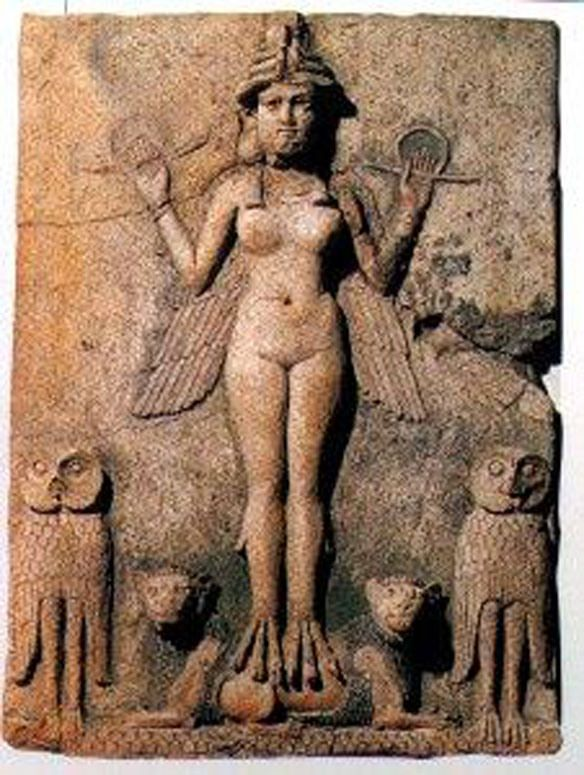
This Zohar passage continues to name some epithets for Lilith that I feel set up the ancient views of her: “Woman of Harlotry”, “end of All Flesh”, “Serpent”, and “End of Day”. Each of these names underscores her as an evil counterpart to the holy. There are even earlier mentions of Lilith-like figures from a Sumerian king-list dating back to 2400 B.C. where a she-demon called a Lilitu a vampiric succubus that could visit men at night and bear their ghostly children (Patai 295). These brief mentions are sprinkled throughout the ancient world with Lilith’s shape and character shifting each time. Although ancient texts are scarce, archeological digs have revealed much. From terracotta pieces that depict Lilith as a female form with owl feet to incantations of protection, Lilith’s power was keenly felt and feared. Raphael Patai describes a collection of bowls that were found in Nippur in Babylonia from an excavation conducted by the University of Pennsylvania. The bowls contain “Aramaic incantation texts” that date back to 600 A.D. (Patai 297). The magical text inscribed in these bowls was used to ward off Lilith(s). Rather than continue to belabor all the sources that include mere mentions of Lilith I will digress with this. Ancient sources depict Lilith as a deep well of dark power that was near impossible to understand, but patriarchy cannot have a powerful woman in the world without making her a source of fear, not admiration.
Barbara Black Koltuv’s book The Book of Lilith, “…is an attempt to tell her story, to evoke her presence in consciousness, and to inquire into her meaning in the modern psyche” (Koltuv Introduction xii). Madness and gender oppression have a rich history with ancient origins that continue to plague us today. The adoption by Western Judeo-Christians of Lilith’s mythic origins and powers is one of the first instances of patriarchy creating a fallen woman and then condemning her for their own gain. Lilith’s story as the Biblical Adam’s first wife was made as a teaching moment of what will befall a woman who questions the status quo, who desires better for herself. For millennia Lilith has been left behind as a villain, a source of fear, and yet she has been recaptured by modern feminists as an icon. While I would agree that she is more than a villain. I would caution against worshipping her. She is a feeling, a moment, a glimpse of the power within all of us. She does not want to be feared, she is not evil, but she is not to be followed lightly. She wants to be seen, to no longer be boxed in–to be herself. Lilith is here to be called upon for the women who are ready to brave the work, forge their own path, and revel in their own power without even a thought to what anyone else is thinking of them. She is a villain. Yes because of what society has deemed acceptable for a woman they can control, but more so because as a villain she is free to be herself. Villainy has given Lilith her power for once they made her a villain, they feared the power they had given her. She was finally recognized as someone who could touch them back.
This series of blogs is born out of both love and anger. It is with the utmost tender love and precious care that I weave these stories, yet I am angered that I have to. Beginnings are hard for me. I want to jump right into the middle of the action and figure it out as I go, but I am constantly reminded that you cannot build a house starting with the windows; the foundation has to come first. An introduction to this problem comes down to my realization that nothing has changed in the way society views and oppresses women ever. You can make the argument that women have the right to vote, they can get divorced, they can legally drink, they can drive, they can hold jobs and public offices. But what that argument is missing is the foundation: the beginnings of femalehood. As Western society settled and congealed into some semblance of order, women were ordered to the bottom–subservient to their patriarchal figures. Patriarchy does a good job at justifying its positions, by producing literature and scholarly thought on how a woman’s constitution was best suited for domesticity. This is where an artificial value system comes into play that makes women believe in their domestic duties as the place where they can achieve what their men are achieving in the public sphere. The traditional thought being if women feel they are appreciated and needed, they won’t be tempted to step out of bounds. Men get the social mobility that their sex allows them, while women chafe against the stifling boundary of confinement. The difference of a few organs should not be the reason for oppression.
A proper lady, the specifics of which changes depending on the time, was meant to wait, be sedentary until the man told them to move. Daya’s song “Sit Still, Look Pretty” could have been sung by Roman women in 509 B.C. The rights of women could only rise when they started below the bottom. How have things not actually changed you may ask? Well while women may have more rights today than before, those rights are conditional as are the public roles women can hold. Women are held to an impossible standard where they have to be enough but not too much. Sure they can work in an office, but how often are female CEOs challenged and undermined? How often are the sexual exploits of a young woman ridiculed and judged, or the lack of sexual experience mocked? Yes, we can vote, but our bodily autonomy is always on the docket to be cut. It’s maddening. Where my thesis comes in is to act as a moderator, an observer of this trend, and narrate it to a broader audience. Things can change but more people need to be as maddened as I am if we are to ever be able to have an actual conversation about what needs to change.
I find that the words of Mary Wollstonecraft pioneer what contemporary scholar Sara Ahmed calls a feminist killjoy. Wollstonecraft’s A Vindication of the Rights of Woman, originally published in 1792, pointed out the ridiculousness of patriarchal oppression and called for actual education of women–not just in domestic duties. Wollstonecraft pointed out what I am arguing now in 2023 (231 years later), “I do frankly acknowledge the inferiority of woman according to the present appearance of things. And I insist that men have increased that inferiority until women are almost sunk below the standard of rational creatures”. Many can pretend that our society is equal now and we have come a long way, but until Mary Wollstonecraft’s novels stop relating to current attitudes, then we still have a long way to go.
I am not arguing that women have never had a voice or a sway when it comes to the way society works. I am arguing that those stories are often not telling the whole truth. Something happens between putting their pens down and someone else reading their words. For too long, their stories have been mitigated, translated, truncated, and censored, if they were even recorded at all before the world could hear them. What could women be writing that would be so threatening to incite such censorship? To a male-dominated world, anything that could disrupt their illusions of power is a threat. If a woman penned a narrative of her experiences in this world, or if she were to begin speaking on a new way of thinking that called for change, that must be stopped. The ultimate goal is to prevent women from writing or stepping out of their boxes before they even begin. This project could go on endlessly, but for the sake of the time I have between now and my graduation, I aim to focus on Western civilization and the dominant views of femininity and female gender roles. This will begin with some mythological beginnings and Christianity and then move through 19th-century literature where the madwoman had her heyday, into second-wave feminist theory and writers, and finishing with my contemporary observations and examples.

 The Affliction of Being Female